Hyde Park is one of Sydney's most loved public spaces, welcoming workers, visitors and residents every day. But Australia's oldest public park has lived many lives since it was proclaimed by Governor Macquarie in the early 19th century.
Records from the City of Sydney Archives reveal a fascinating history. From roaring lions and political speeches to hidden railway works and an obelisk that doubled as a sewer vent, here are 10 surprising stories from Hyde Park's past.

1. Hyde Park began life as a racetrack
When Governor Macquarie proclaimed Hyde Park in 1810, it was much larger than the park we know today. After being cleared of scrub, it was used as a racecourse until 1821 before evolving into a popular place for recreation and organised sport.
By the 1820s, cricket matches attracted crowds to the park and it became a place to see and be seen.

2. Busby’s Bore brought Sydney’s water to Hyde Park
In 1837, a new water supply known as Busby’s Bore brought water downhill from Lachlan Swamp (later the site of Centennial Park) to Hyde Park. A raised pipe in the park, near today’s Park Street, was used to fill the town’s water carts.
The system was extended by the council and piped water was used in drinking fountains across Sydney by 1844.

3. The obelisk that doubles as a sewer vent
Standing at the corner of Elizabeth and Bathurst streets, Hyde Park's sandstone obelisk looks like a grand Egyptian monument. But the first of many civic monuments in the park was built in 1857 as the centrepiece of Sydney's sewerage system.
The structure helped vent gases from underground sewers high into the air, where they were intended to “be so impregnated with, or so diffused amongst, the atmosphere that they could exercise no prejudicial effect or unpleasantness whatsoever”. It wasn’t effective and the council received many complaints about unpleasant smells. For more, see the Hyde Park obelisk collection.

4. Lions, tigers and bears in the city
Long before Taronga Zoo, Hyde Park temporarily housed some unusual residents.
In 1851, the merchant William Beaumont received permission to exhibit a tiger, bear and deer in the park.
Decades later, Wirth Brothers kept its animal menagerie in the park. Not everyone was impressed. One resident complained that "the roaring of the lions is too terrible and nerve wracking".

5. Hyde Park was a hub for public debate
For generations, Hyde Park has been a gathering place for public discussion and political activism.
From the 1850s, crowds gathered beneath the famous Tree of Knowledge to hear speakers discuss politics and civic issues. It was Sydney's first speakers' corner, attracting everyone from campaigners and election hopefuls to curious spectators, with some of the gatherings dubbed a “congregation of undesirables”.

6. Sydney Town Hall could have ended up in Hyde Park
In 1858, the northern end of Hyde Park facing Macquarie Street was one of several sites considered for the Sydney Town Hall.
After decades of debate between the council and colonial government, the current town hall site was eventually secured in the 1860s. For more information, see Securing a site for the Town Hall.

7. Hyde Park was dug up for the railway
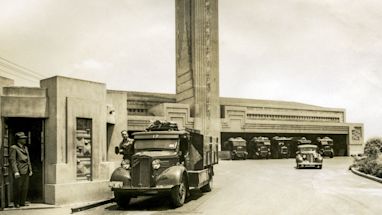
In the early 20th century, much of Hyde Park was transformed into a massive construction zone.
Work on the City Circle railway began in 1916, requiring large sections of the park to be dug up to make way for St James and Museum stations, and underground railway tunnels. For years, people could no longer use the park. A file in the City of Sydney Archives records that a huge hill of excavated earth sat at the southern end of the park for so long that it became known as “Mount Stokes”, named after the Lord Mayor of the time.

8. Hyde Park's unbuilt future
As the railway line was nearly completed, a design competition was announced to reimagine the park. English engineer Norman Weekes won the contest. Influenced by the City Beautiful movement, Weekes’s plan included Sydney Aboriginal names for some of the park’s features and a library facing Liverpool Street. Most of the proposed designs by Weekes were never realised but the plans are still held in the City of Sydney Archives. For more information, see Hyde Park plans and sketches by Norman Weekes, 1927-1932.
Some of the rejected competition designs are recorded on file and include a tower with a lift to view the park from above, an open-air Greek-style theatre and a semi-underground parking station.

9. Hyde Park helped feed Australia's military
From December 1939 to March 1946, Hyde Park hosted the volunteer-run Anzac Buffet. Staffed mainly by women volunteers, it provided more than 4 million free meals to service personnel during World War 2. The buffet fed military staff in the Domain during World War 1.

10. Hyde Park helped inspire Sydney Festival
Before Sydney Festival, there was the Waratah Spring Festival.
Opening in 1956 by the Sydney Committee, it was led by the premier and lord mayor, and organised by the City of Sydney to enliven the city each spring. Floral displays, an art competition, wood chopping and open-air concerts took place in the 1960s. In 1964, 45 decorated floats and up to 5,000 people took part in a procession. The last of 18 festivals took place in 1973 before turning into the Sydney Festival.
These stories are just a few examples of Hyde Park's rich history. The records, photographs and plans behind them are preserved in the City of Sydney Archives, which celebrates 50 years of professional archival care in 2026.
For more on Hyde Park, see our published history and highlights in the Archives and History Resources catalogue.
Published 16 November 2026