The condemnation and demolition books, comprising almost 5,000 photographs and associated glass plate negatives, are a key collection held in the City of Sydney Archives.
From 1900, the City of Sydney began hiring professional photographers to document “old, insanitary and ruinous” buildings when they were condemned, and usually before they were demolished. The photographs were intended as a form of evidence in case of disputes and to record what was about to be lost.
Documenting Sydney’s profound transformation in the first 2 decades of the 20th century, the photographs incidentally capture the largely working-class neighbourhoods and people being displaced by commercial and government redevelopment.
Small houses and old pubs, little warehouses and factories, crumbling stables and quaint shops – many dating from the 1840s and untouched for more than 50 years – were swept away in piecemeal demolitions and whole neighbourhoods cleared by government order.
For the Australian Heritage Festival, we’ve selected some highlights. Check them out below or view the full collection in the City of Sydney archives catalogue.

Goulburn House, corner of Druitt and Kent streets, circa 1901
The elegant ‘board and residence’ was previously a pub named the Goulburn Hotel in the 1880s. Sydney Town Hall dominates the horizon behind. An election poster fixed to the cast iron balcony reads ‘Don’t Forget CHUCK’. Captain J A Chuck was a candidate in the Lang Division of the 1901 state election.

Corner of Pitt and Goulburn streets, 1902
This panorama, composed from 2 separate glass plates, shows the north-west intersection of the 2 streets. Tall cranes in the distance are busy constructing Anthony Hordern & Son’s enormous new retail emporium on Brickfield Hill. Chinese businesses, factories and lodging houses rented shopfronts in Fox’s Buildings opposite, including Quan Hing’s store and Kwong Mow On & Co, importers.

Bowden’s Corner at Hunter and Castlereagh streets, 1907
Thomas Kite from Bathurst built a home here in the 1840s, which later became a pub run by Mrs Bowden. The diminutive corner building was a landmark because a large Norfolk pine grew through the middle of it, which was used as a coat rack for the hotel patrons. The building and tree were demolished in 1909.

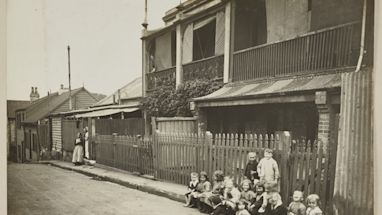
78 Stanley Street, East Sydney, c.1912
Kids play on the street out the front of a half-demolished cottage, once occupied by A Pointing. The steep incline of Stanley Street would have been perfect for wheelbarrow and billycart races. A woman looks down from the balcony of Charles H Grigg’s grocery shop on one side. Mrs Fanny Usher sold second- hand clothes from her shop on the right.

Employment agencies at 23–31 Elizabeth Street, c.1913
Lucretia and Florence Wilton established the Select Registry at 29 Elizabeth Street in 1905. Other employment agencies in the same patch included Alfred Israel’s Inter-State Servants Office and Ryan & Co Labour Agents. Female domestic servants hired from registries and exchanges worked in private homes, boarding houses and hotels. Their hours were long, the work was physically gruelling and the pay was paltry.

10-12 Harwood Street, Pyrmont, 1917
The City of Sydney cleared buildings along Harwood Street for the Pyrmont Bridge Road project in the early 20th century. The timber double-storey terrace with boarded up windows was being demolished. One half of the terrace had been a grocery store run by W Fross. Pyrmont locals pick over an empty block of land next door. The dome of the Queen Victoria Building dominates the skyline.

Fowlers Pottery, Australia Street and Parramatta Road, Camperdown, 1920
The family business was started by Enoch Fowler in 1837 and taken over by his son Robert in 1879. Production moved to Camperdown in the 1850s, with kilns and chimneys peppering the 2-hectare site on Parramatta Road. Fowlers produced goods including ginger beer bottles, paving bricks and oven tiles but its speciality was drainpipes.

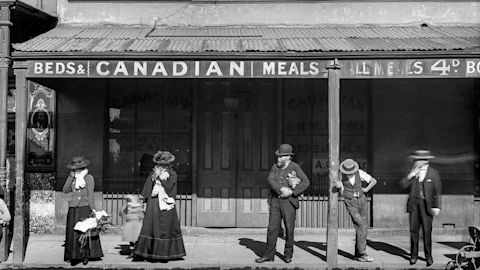
The Canadian Dining Rooms at 4 George Street west (today's Broadway) c1901
The Canadian Dining Rooms offered a bed for the night, and meals for 4 pence ($X or X cents). The single-storey building near the corner of Regent Street had 18 rooms. The restaurant and boarding house was run by Austin Clarke in 1901, but women ran it previously: Isabella Hawke in the 1890s and Mary Mondrion in 1900. The building was demolished in 1902.
Want more?
Explore the photographs on a map and see the same places today.
Visit the City of Sydney Archives and history resources catalogue to view and download exhibition photographs.
Check out all the events happening for Australian Heritage Festival.
Published 22 April 2026