Nawfel had lived in Sydney longer than anyone else among his work mates. It took a casual conversation to make him realise it.
He and his colleagues were sharing where they came from and how long they had been living in Sydney.
“The majority of them were born and raised in Australia, with their Aussie accents,” Nawfel said.
“But towards the end, I realised that out of these 20 people, I was the one who’d lived in Sydney the longest.
“It was a very funny moment to realise how local you are without even knowing it.”
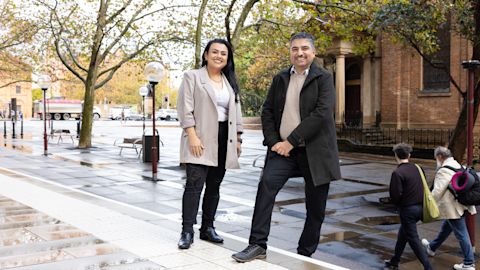
The ambassador from the Refugee Council of Australia shared his story ahead of Refugee Week, on 14 to 20 June.
The theme for Refugee Week this year is ‘A million stories’, honouring the one million refugees who have resettled in Australia with permanent humanitarian visas since the end of World War 2.
Nawfel
Nawfel is a regional clinal trial manager in the pharmaceutical industry. He arrived in Sydney as a refugee more than 20 years ago and he’s lived here ever since.

It’s not only the number of years he’s lived here that makes Nawfel a local. He’s also very connected with his community, volunteering with the soccer team, mentoring Scouts and teaching ethics at the local school.
For him, connecting and contributing to his community is a way to bridge differences in a multicultural society.
It was fear and hatred of difference that forced him to flee Iraq for Syria in 2003. There he waited for his application to come to Australia as a refugee to be approved.
"Anyone can be a refugee if they've been treated wrongly."
“When fear is used by people to instigate hate, hate becomes violence. And when you have violence, you don’t have a place for others,” Nawfel said.
“Seeing now what’s happening with all this polarisation – it’s scary.
“Unless people like us stand up and speak up, no one will know what they’re losing.
“Anyone can be a refugee if they’ve been treated wrongly. I’ve seen that firsthand where I came from.”
It’s a view shared by Nawfel’s fellow Refugee Week ambassador, Shabnam.
“Who looks like a refugee? Anyone can be a refugee at any point in time,” Shabnam said.
“I would really love to make a difference in people’s mindsets and their idea of what a refugee is. Because I’m telling you now, we’re not all the same.”
Shabnam

As someone who arrived in Australia in the 90s as a child refugee, Shabnam has her own unique story.
Her parents decided to leave Iran as their family were persecuted because of their religion.
She was 7 and a half years old.
“We left in the dead of the night... I was old enough to walk. All I remember is my dad telling me it’s going to be okay for me to just have a rest, just sleep a little bit,” she said.
But her memories of the journey are fragmented, broken up by the trauma. It’s the memories of adjusting to life in Australia that are more vivid for her.
“I ran into so many problems… not knowing English, constantly supporting my parents to assimilate into the culture, missing a lot of school. My mum and dad would take me to all their appointments just to interpret because somehow I learned English,” she said.
"Who looks like a refugee?... I’m telling you now, we’re not all the same.”
“Who I’ve become is because of what my journey was, the trauma and hardship. I learned to build on myself and make that more of a positive aspect rather than a negative.”
Shabnam’s experiences have led her to the work she does today, supporting children and families with a refugee background and providing cultural consultations to other social workers.
Her message to everyone this Refugee Week would be to embrace someone else’s culture, even if you don’t know anything about it.
“If you get to know that person and you learn something about their culture, it will bring people together.
“Try a new food, learn something new and have a wonderful time,” she said.
Hear Shabnam and Nawfel share their experiences at Refugee Week, 14 to 20 June.
Published 8 June 2026, updated 9 June 2026